
Boxing Terminology: A Glossary for Beginners
Every sport has its vocabulary. Boxing is no exception. There’s a mix of equipment names, technique terms, training jargon, and class-specific shorthand that can feel like a foreign language in your first weeks. This post is a plain-language glossary of the terms you'll hear most often in our boxing gym, organized by category.
If a coach uses something that isn't on this list, ask. The only way not to learn the vocabulary is to stay silent about the parts you don't know.
Equipment
Wraps. Long cotton/elastic strips you wrap around your hands and wrists under your gloves. They compress the small bones of the hand, support the wrist, and are not optional. Standard length is 180 inches. We have a full post on how to wrap your hands that you can check out.
Gloves. What you wear on top of wraps. Boxing gloves come in different weights (measured in ounces) — 12oz, 14oz, and 16oz are the common class weights. Heavier gloves are more padded; lighter gloves are for sparring or specific bag work. If you're unsure what to buy, ask a coach.
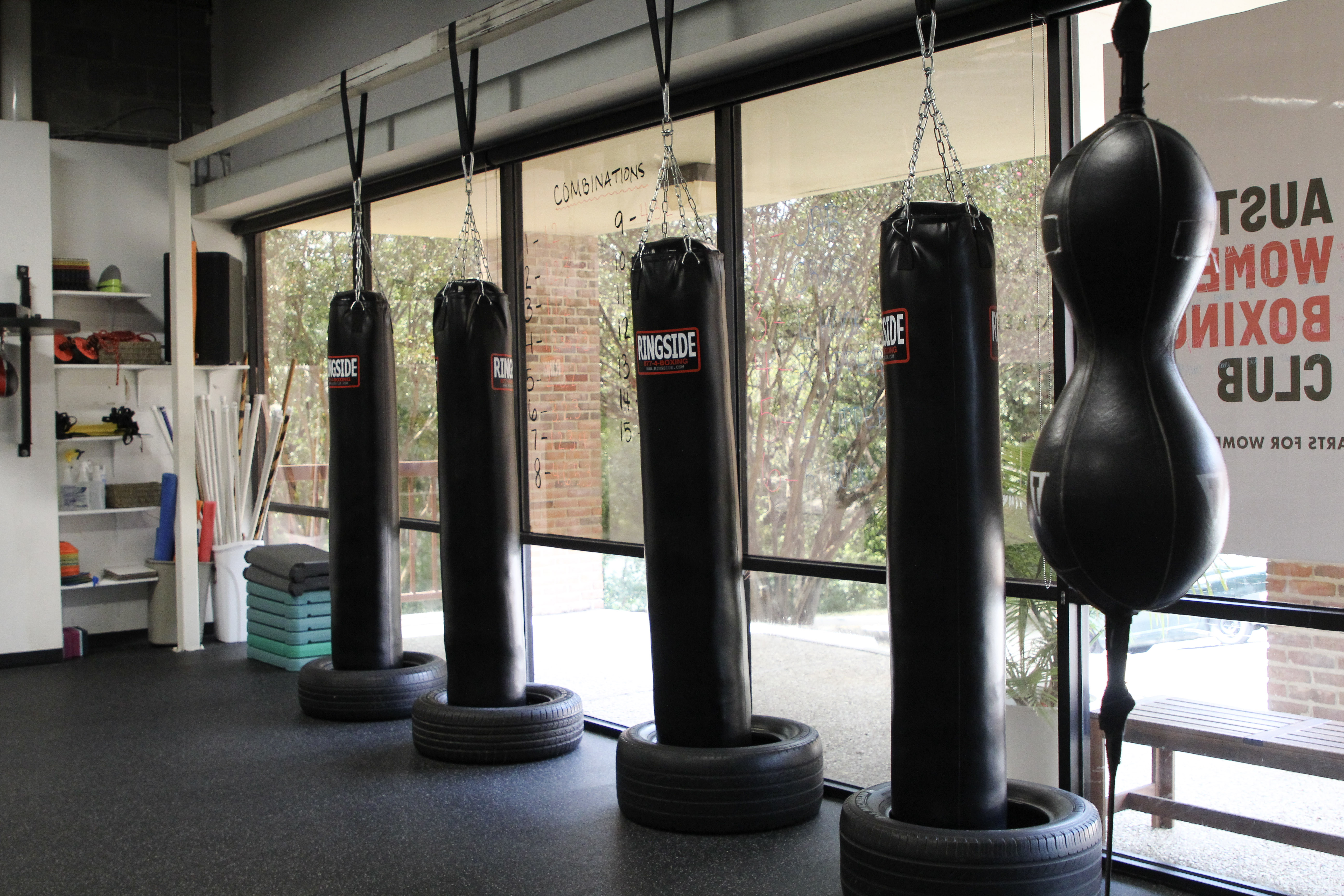
Heavy bag. The big hanging bag in the gym. Usually 70-100 pounds. This is where you do bag rounds, practicing combinations and power at range.
Double-end bag. The small bouncy ball-on-a-cord hanging between floor and ceiling. It returns unpredictably and trains timing, accuracy, and head movement.
Speed bag. The small, teardrop-shaped bag hanging from a platform at eye level. It trains rhythm and shoulder endurance. Making one work takes a while.
Mitts (or focus mitts). The padded targets coaches wear on their hands for one-on-one work. Mitt work is where the coach can correct you in real time, in a way that isn't possible on a heavy bag.
Ring. The square (actually a square — "ring" is historical) elevated platform with ropes where sparring and fights happen. You'll see this in the gym but may not use it in foundations classes.
Mouthguard. Required for sparring/high contact drills. You'll need one before you move into any of our Intermediate or Advanced classes.
Class structure
Round. In many cases, that’s three minutes of work followed by one minute of rest. It’s the unit of almost everything in boxing. When a coach says "we're doing six rounds on the bag," they mean chunks of work and rest time on the bag. Sometimes round lengths will vary depending on the exercise.
Shadowboxing. Boxing without a bag or opponent — moving, throwing punches, practicing footwork in open space, usually in front of a mirror. It's one of the most valuable training tools in the sport.
Bag work. Any rounds you spend hitting a heavy bag, double-end bag, or similar. What it sounds like.
Mitt work. One-on-one training with a coach or fellow student holding pads. This is where real technical correction happens, so don’t treat your mittholder like a heavy bag you can go crazy on!
Drill. Any structured partner exercise — a defined set of punches, defenses, or movements that you and a partner work through together. In Basics and All-Levels, no glove to head contact is being made here.
Sparring. Controlled practice fighting with a partner, using headgear, mouthguards, and heavier gloves. Sparring is where you apply everything you've learned against a live, thinking opponent. At AWBC, sparring happens in advanced classes only.
Stance and footwork
Orthodox. Standing with your left foot forward, right foot back. The default for right-handed boxers.
Southpaw. The mirror — right foot forward, left foot back. The default for left-handed boxers.
Stance. How you stand — feet shoulder-width apart, with one forward and one back, weight balanced, hands up by your face. Your stance is the base of everything.
Pivot. Rotating on one foot to change the angle at which you’re facing your target.
Step. Moving your lead or rear foot first, followed by your other foot, to cover distance or change angle. Goal is to end up back in your stance with balance.
Shuffling. Covering more distance in the ring or around the bag by taking quick and fluid steps on the balls of your feet. You’ll be a little more upright in your stance when you do this.
Range. How far apart you and your opponent are. "In range" means close enough to hit each other. "Out of range" means not.
Defense
Slip/Slide. Moving your head off the center line to avoid a straight punch, without moving your feet.
Duck. Bending at the knees with the hands up to avoid a punch to the face. We’re tricking you into doing squats with this.
Roll. Moving the upper body/head in a circular motion and bending the knees. Used to defend against hooks.
Block. Absorbing a punch on your gloves or forearms, staying in defensive posture.
Other things you'll hear
"Hands up." Your default defensive position — hands by your face to protect your head. Coaches will say this many times....because it's necessary. 😉
"Breathe." Boxing-specific instruction to exhale on the exertion of each punch. Under stress, people hold their breath. Don't.
"Reset." Return to stance. Usually called out after a combination.
"One more round." A phrase that is, on occasion, a lie. Especially in one of Coach Alex’s classes.
“Squash the bug!” Grind the ball of your foot into the ground while turning your hips and shoulders. Used when throwing a technically sound punch.
One last thing
You're not expected to know any of this on day one. You’re really not expected to know anything on day one! Breathe, relax, have fun, and ask us questions when they come up. We love to help!